What a Kolinsky sable brush actually is
"Kolinsky sable" is a trade name, not a species. The hair comes from the tail of the Siberian weasel, Mustela sibirica — not from a sable, and not from any animal that answers to the word. Brush makers sort that hair by length and taper, dress it into a round head, and grade the finished head by one test: does it gather into a single point?
Two features do most of the work. The tapered tip collects into one fine point instead of splitting into a fan. The belly — the widest part of the head, between the tip and the metal ferrule — holds liquid so it can be released in a controlled line rather than dumped in one stroke. Together they give you a brush that feels springy and returns to shape after you press it against a model.
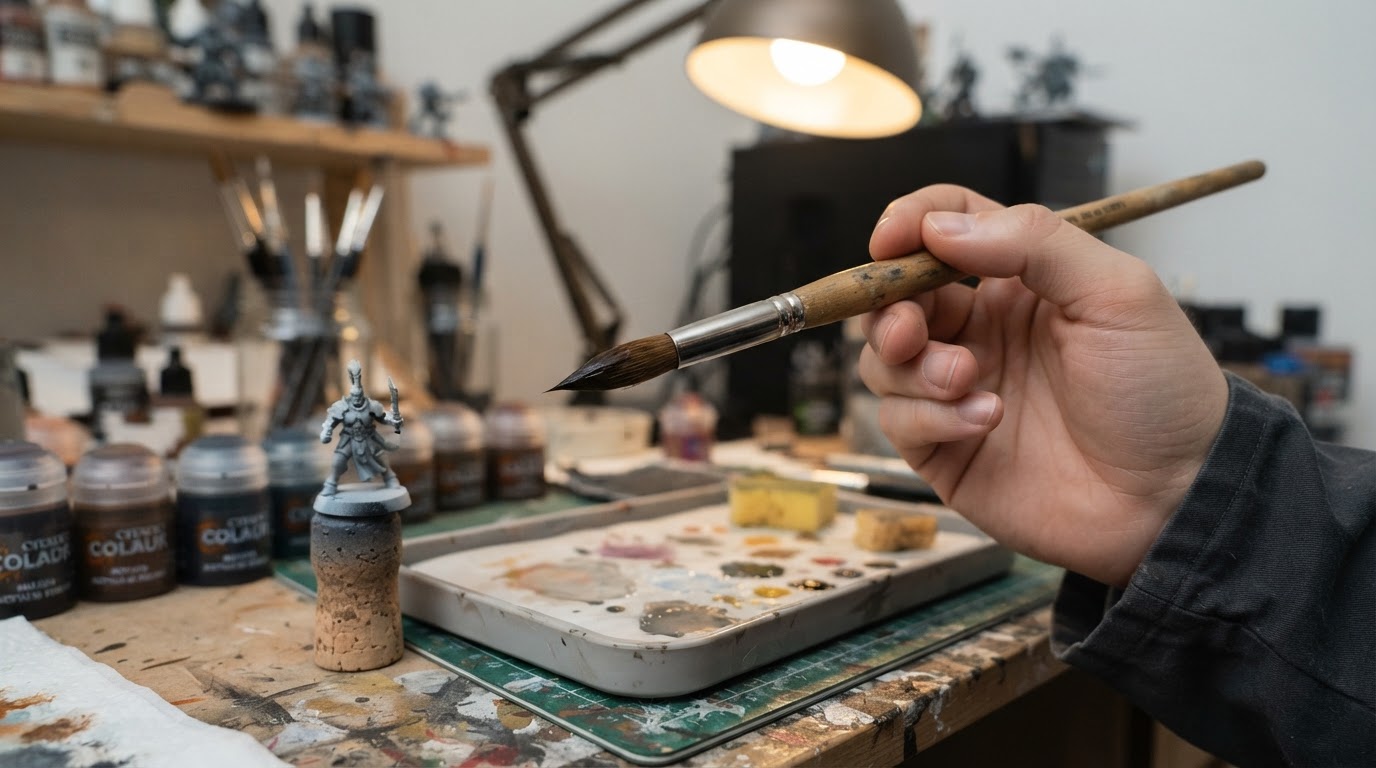
That is the entire product. A Kolinsky sable brush has no electronics, no settings and nothing to update. It is hair, glue, metal and wood, and the difference between a good one and a bad one shows up in how the tip behaves after twenty minutes of painting, not on a spec sheet.
Why miniature painters reach for one
Miniatures get painted with thinned paint and small, deliberate strokes. You need a tip that lands exactly where you put it, because a stray millimetre on a face or an eye is instantly visible. You also want to load the brush once and paint several edges before re-dipping, which is what the belly is for.
Synthetics can be excellent, but their behaviour changes over a session: a synthetic that feels sharp when dry may hook or splay the moment it meets wet paint. Kolinsky hair tends to hold its point through that cycle, which is why painters describe the difference as "it still points" rather than "it feels softer".
The limitation belongs next to the praise. A Kolinsky round is a detail tool, not an all-purpose brush. It is the wrong choice for drybrushing, stippling, scrubbing terrain, spreading texture paste, or working with solvents and varnishes that strip natural oils out of hair. Treat one Kolinsky as the only brush on the desk and you will kill it in weeks, then decide natural hair is overrated. Keep a cheap synthetic for the destructive jobs and the good brush for the careful ones.
Who should buy one, and who should wait
A Kolinsky brush pays off when you already paint small details regularly and your hand is steady enough that you are not mashing the tip into the miniature. Two signs you are ready: you can thin paint to a glaze and still control it, and your current brushes fail by losing their point rather than by shedding hair into the paint.
Three signs you should wait:
- You are still learning pressure control. A fine tip rewards a light hand and punishes a heavy one. Learn on something cheap.
- You paint a model or two a month. The hair sits idle, and idle time does not improve a brush.
- Someone is buying it as a gift. Size, handle thickness and spring are personal. A gift card or a small starter set is a safer present than one specific round.
If you land somewhere in between, buy a single brush rather than a set and treat it as a test of whether natural hair suits the way you paint.
Sizes and shapes that matter for detail work
The most common buying mistake is trusting the number printed on the handle. Brush sizes are not standardized between makers, and a "2" in one line can sit close to a "1" or a "3" in another. Compare the head itself — width across the belly, and length from ferrule to tip — instead of the number.
Rounds cover almost everything on a miniature:
- Size 1 round. The workhorse. Basecoats on small areas, then most detail work once you have control.
- Size 0 round. Eyes, teeth, straps, edge highlights, and anywhere a size 1 is simply too broad.
- Size 2 round. Larger panels, cloaks and skin on bigger figures, where a size 1 would need two passes.
Going smaller than size 0 is usually a trap. A tiny head holds less moisture, the paint dries on the tip while you are still lining it up, and you end up dipping constantly — which is exactly when a tip gets bent. If a size 0 feels too large, the problem is usually paint consistency or brush angle, not brush size.
Shapes matter less than shopping pages suggest. A round with a good point handles detail work; a liner or rigger earns its place only if you paint long thin lines such as reins or scratches; a flat is useful on terrain edges, not on faces. Buy the rounds you will actually use before you buy a set.
Care and tip maintenance
Kolinsky brushes usually die at the ferrule, not at the tip. Paint that dries in the base of the head spreads the hairs and locks in a splay, and water that wicks up into the metal crimp softens the glue holding everything together. Both are avoidable with habits that take seconds.
The routine is short: rinse the brush often while you paint, clean it with brush soap at the end of a session, reshape the damp tip into a point with your fingers, then let it rest flat or handle-up so nothing presses on the hair.
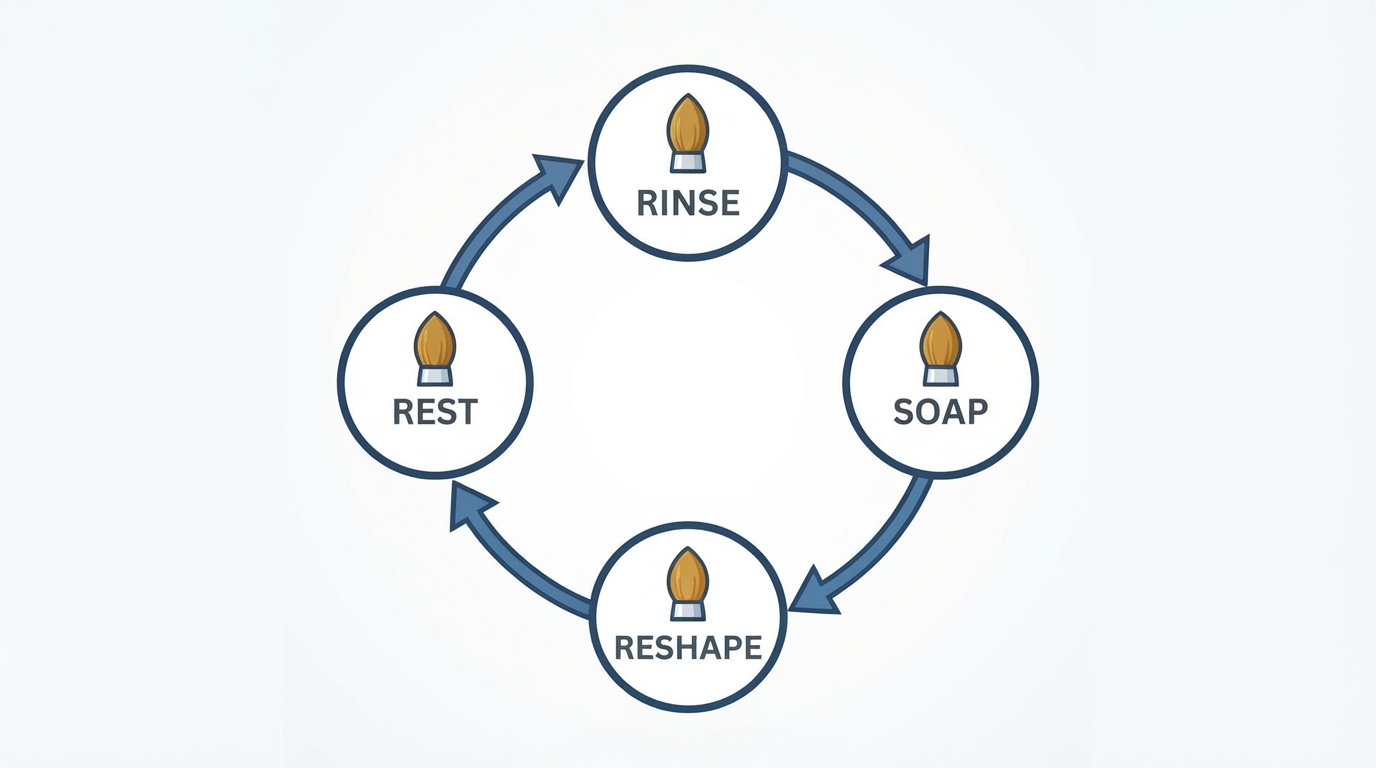
A few rules do the heavy lifting:
- Never stand a brush tip-down in water. Use a shallow rinse jar you can lay the brush in, or a stand that grips the handle.
- Work soap into the base of the head, not just the tip. Rinse, lather, rinse again until the water runs clear.
- Reshape and dry pointed. A brush that dries splayed tends to stay splayed.
- Keep a guard on for travel and storage. It costs nothing and prevents most bent tips.
- Reserve synthetics for metallics, washes, drybrushing, glue and varnish. These jobs are hard on hair and do not need a fine point.
You can sometimes rescue a hooked tip with soap and warm water, but once hair has taken a permanent set, care will not bring it back. That is why the habits matter more than the price of the brush.
What the price tiers actually buy
Retail prices for Kolinsky brushes move around, and the same line can be easy to find one month and hard to restock the next, so check the current listing rather than trusting a number you remember. What the higher tiers generally buy is consistency: a head that points reliably, a ferrule that is crimped and sealed cleanly, and a handle that does not feel hollow in the hand.
Worth checking before you pay:
Check | What you are looking for |
|---|---|
The tip | Damp it and roll it — the hairs should gather into one point with no split hair sticking out. |
The ferrule | A clean crimp with no glue oozing out and no gap where water can wick in. |
The belly | Enough width to carry a useful load without the head ballooning. |
The return policy | Quality varies between individual brushes, even inside the same line. |
The line, not the label | "Kolinsky-style" blends and cosmetic lookalikes sit at lower tiers; check what the maker says is in the hair. |
One good brush usually beats a multipack, provided you keep it away from the destructive jobs. If you cannot verify the current price, stock and hair content of a listing, treat that as a reason to check another retailer rather than a reason to guess.
Lower-cost alternatives that get you most of the way
You do not have to start with natural hair. A modern synthetic blend holds a usable point for basecoats, metallics and washes, and it tolerates the abuse that would ruin a Kolinsky round. It softens and loses its fine point sooner, so treat it as a basecoat and blocking-in tool rather than an eye-and-edge tool.
Softer natural hairs — squirrel, pony and their blends — carry a lot of liquid and feel gentle, but they lack the spring that returns a Kolinsky tip to shape, which is why they suit washes and large smooth areas more than fine detail.
If you would rather see what an experienced painter actually keeps on the desk, a curated gear list is a faster starting point than a spec sheet. The miniature painting supplies page on Tactile Hobby names the brushes, paints and tools in use on that desk — including a Rosemary and Co Series 33 in size 2 — and pairs budget and premium picks for the same slot, so you can compare real choices instead of product photos.
The hybrid approach is the one most painters settle on: a couple of cheap synthetics for basecoats, washes and metallics, plus a single Kolinsky round for the work where the point is the whole point. That combination costs less than a full set of natural-hair brushes and covers more of what you actually paint.
A short way to decide
If you paint detail regularly and your current brushes fail by losing their point, buy one Kolinsky round in the size that matches your figures — most people land between size 0 and size 2 — and learn to care for it before you buy a second.
If you are still building control, paint infrequently, or you are shopping for someone else, stay with synthetics for now and put the difference into paint and a decent brush soap. A fine brush teaches you nothing a cheap one cannot; it only rewards the habits you already have.
Either way, verify what you are buying. Damp the tip, look for a single point, check the ferrule, and confirm the current price and stock at the shop you are actually ordering from.